
How Much House Can I Afford in 2026? Salary-Based Calculator & Guide
Last updated: September 21, 2026
How much house can I afford? A general rule: you can afford a home priced 3x to 4.5x your annual gross income. With a $75,000 salary, that's roughly $225,000 to $337,500. But the real answer depends on your down payment, existing debts, credit score, interest rate, and location. A buyer with zero debt and a 780 credit score can afford significantly more than someone with a $500/month car payment and a 640 score, even at the same income.
The 28/36 rule gives you a more precise number. It says your monthly housing payment should stay below 28% of your gross income, and your total debt payments below 36%. This guide walks you through exactly how to calculate your home affordability, shows real-dollar examples at every salary level, and covers the factors that lenders actually care about.
Below you'll find specific salary-based tables, worked examples, and a breakdown of the hidden costs most online calculators ignore. Use these numbers to set a realistic home buying budget for 2026, then get matched with an advisor who can give you a real pre-approval number.
The Quick Answer: Home Price by Salary

This reference table shows how much house you can afford at different income levels using the income multiplier method. "Conservative" assumes minimal debt, modest down payment, and staying well within the 28% housing ratio. "Stretch" assumes excellent credit, low debt, and a larger down payment.
The last column is arithmetic on the first one, not a payment on any loan. It is 28% of that annual income divided by twelve, which is the ceiling the 28/36 rule puts on total housing costs. Property taxes, homeowners insurance and any mortgage insurance are paid out of it first, so what is left to carry a loan is smaller than the figure shown. Nobody is quoting you this number, and it is not what a lender would price.
| Annual Income | Conservative (3x) | Moderate (3.5x) | Stretch (4.5x) | Max Housing Budget (28% of income) |
|---|---|---|---|---|
| $50,000 | $150,000 | $175,000 | $225,000 | $1,167 |
| $60,000 | $180,000 | $210,000 | $270,000 | $1,400 |
| $75,000 | $225,000 | $262,500 | $337,500 | $1,750 |
| $100,000 | $300,000 | $350,000 | $450,000 | $2,333 |
| $120,000 | $360,000 | $420,000 | $540,000 | $2,800 |
| $150,000 | $450,000 | $525,000 | $675,000 | $3,500 |
Important: These are starting estimates. Your actual number will be higher or lower depending on your down payment, debts, credit score, and location. A $100,000 earner with $800/month in car and student loan payments might only qualify for $300,000, while the same earner with zero debt could push past $400,000.
The 28/36 Rule Explained
The 28/36 rule is the most reliable method for calculating mortgage affordability. It's been the standard guideline used by financial planners and recommended by the Consumer Financial Protection Bureau (CFPB) for decades. Here's how it works:
- 28% rule (front-end ratio): Your total monthly housing payment (principal, interest, taxes, and insurance, or PITI) should not exceed 28% of your gross monthly income.
- 36% rule (back-end ratio): Your total monthly debt payments (housing costs plus car loans, student loans, credit cards, and other debts) should stay below 36% of your gross monthly income.
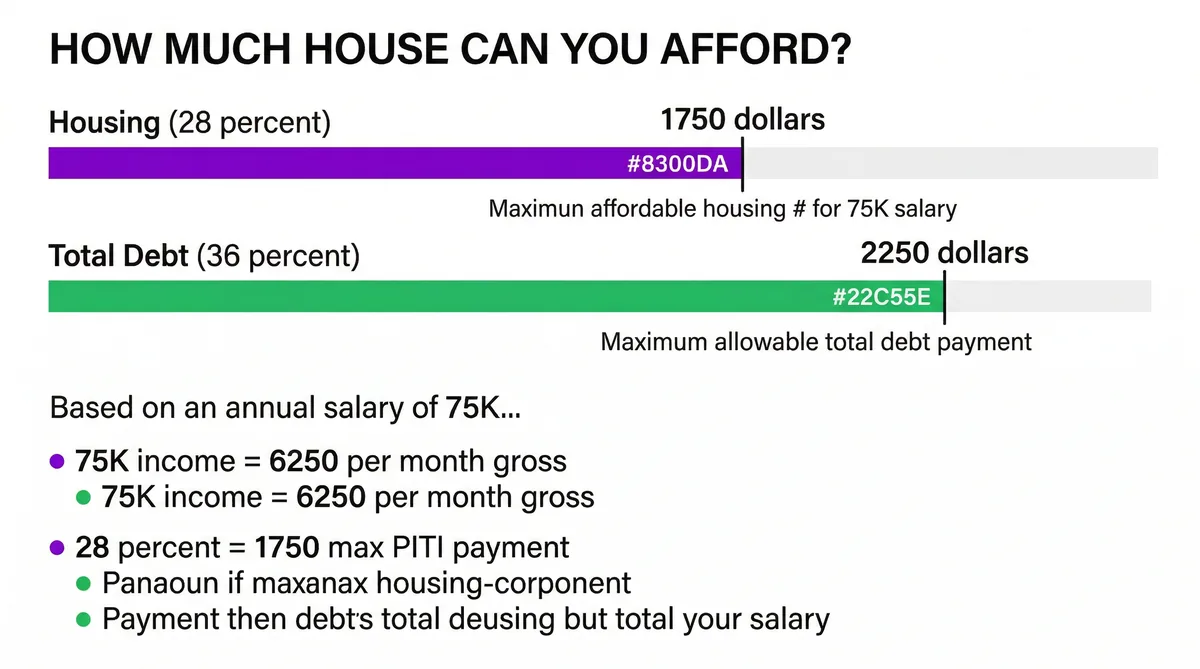
28/36 Rule Example: $80,000 Income
Let's walk through a real calculation for someone earning $80,000 per year:
| Calculation | Amount |
|---|---|
| Gross monthly income | $6,667 |
| 28% of gross (max housing payment) | $1,867 |
| 36% of gross (max total debt) | $2,400 |
| Existing monthly debts (car: $350, student loans: $200) | $550 |
| Remaining for housing (from 36% limit) | $1,850 |
| Your max housing payment (lower of the two) | $1,850 |
Notice how existing debts limit your housing budget. Without the $550 in monthly debts, this buyer could use the full $1,867. With them, the 36% back-end ratio becomes the binding constraint at $1,850.
Your own income and debts will move which of the two lines binds. You can run your own salary through the same two ratios and see the price range they leave you, along with which ceiling is the one actually stopping you.
Why lenders may approve more, and why you shouldn't take it. Many lenders approve borrowers at a 43% to 50% debt-to-income ratio. On an $80,000 income, that's up to $3,333/month in total debt. That approval doesn't mean you can afford it. Buyers who stretch past 36% DTI are significantly more likely to experience payment stress and default. Stick with 28/36 as your ceiling, not your target.
What Lenders Actually Look At (Beyond Income)
Your income sets the baseline, but five other factors determine your real home buying budget. Change any one of them and your affordability shifts by tens of thousands of dollars.
1. Credit Score
Your credit score is the biggest single lever on what a loan costs you to carry. It moves both the price a lender puts on the money and the mortgage insurance premium stacked on top of it. BEDRWay is not a lender and does not publish rates, so here is what each band changes rather than what it costs:
| Credit Score Range | What it changes |
|---|---|
| 760+ | The widest choice of lenders and the cheapest mortgage insurance band. Your score is not what is limiting the file. |
| 700-759 | Priced close to the top tier. Down payment and existing debt will move your budget more than the remaining score gap does. |
| 660-699 | Pricing and PMI both start to tighten. In this band, 40 points of score repair is usually worth more than another month of saving. |
| 620-659 | Conventional is available but expensive to carry, and PMI sits at its steepest. FHA is often the cheaper route until the score moves. |
Across a 30-year loan the distance between the top band and the bottom is measured in tens of thousands of dollars of interest. That is why repairing your score before you apply is one of the highest-return moves available to a buyer, and why it is worth doing before you start shopping rather than during.
2. Down Payment
A larger down payment does three things: it lowers your loan amount, it reduces or removes PMI, and it improves how a lender prices the loan. Here is how down payment size changes your purchase power on a $75,000 income, holding the maximum monthly housing payment at $1,750 and the interest rate constant across all four rows:
| Down Payment | Max Home Price | Loan Amount | Monthly PMI? |
|---|---|---|---|
| 3% ($7,200) | ~$240,000 | $232,800 | Yes, about $120 |
| 5% ($12,500) | ~$250,000 | $237,500 | Yes, about $100 |
| 10% ($28,000) | ~$280,000 | $252,000 | Yes, about $75 |
| 20% ($62,500) | ~$312,500 | $250,000 | No |
Going from 3% to 20% down increases your purchase power by about $72,500 and eliminates the $100+/month PMI cost. But saving 20% takes years for most buyers. A 5-10% down payment is the sweet spot for most first-time buyers who want to buy sooner without stretching too thin.
3. Existing Debt
Every dollar you pay toward existing debt each month is a dollar that can't go toward your mortgage. Lenders calculate your debt-to-income ratio (DTI) by adding up all monthly minimum payments (car loans, student loans, credit cards, personal loans) and dividing by your gross monthly income. The lower your DTI, the more of your income is left to carry a mortgage.
4. Interest Rates
Rates move, sometimes sharply inside a single quarter, and they move your budget with them. A small change in the rate you are offered changes how large a loan a given payment will support, and over a 30-year term that effect is large. BEDRWay is not a lender and does not publish rates, so the practical advice is the shopping discipline rather than a number: get quotes from three or more lenders, on the same day, for the same loan and the same down payment, because that is the only way to see what you are actually being offered. The Bureau of Labor Statistics tracks economic indicators that influence rate movements.
5. Location
Two homes with the same price can have wildly different monthly payments depending on where they are. Property taxes range from 0.31% of home value in Hawaii to 2.23% in New Jersey. Homeowners insurance varies from $800/year in Vermont to $4,000+/year in Florida and Louisiana. A $350,000 home in Texas (1.60% property tax, ~$2,400 insurance) costs $700/month more in taxes and insurance alone than the same priced home in Colorado (0.51% tax, ~$1,600 insurance).
Real-World Example: $75,000 Income
Let's build a full, realistic mortgage affordability calculation for someone earning $75,000/year with a decent but not perfect financial profile.
Buyer Profile
- Annual income: $75,000 ($6,250/month gross)
- Credit score: 680
- Savings: $18,000
- Monthly debts: $200 student loan payment
- Down payment: 5%
Step-by-Step Calculation
| Step | Working | Result |
|---|---|---|
| Gross monthly income | $75,000 ÷ 12 | $6,250 |
| Max housing payment (28%) | $6,250 × 0.28 | $1,750 |
| Property taxes, typical | about $300 | 17% of that budget |
| Homeowners insurance, typical | about $125 | 7% of that budget |
| PMI at 5% down | about $90 | 5% of that budget |
| Left to carry the loan itself | after those three come out | 71% of that budget |
| Home price this supports | 5% down, $200 student loan, 680 score | about $200,000 to $218,000 |
The honest number here is the 71%, not a dollar amount. Property taxes, insurance and PMI take 29% of the housing budget before any of it reaches the loan, and only what is left can carry the loan itself. Priced that way, this buyer lands at roughly $200,000 to $218,000 of home, against the $337,500 the 4.5x income rule of thumb would have suggested. Where you fall inside that range depends on the rate a lender quotes you and on what your state charges in taxes and insurance, which is why it is a range and not a single figure.
What Happens If This Buyer Improves Their Credit?
If the same buyer raises their score from 680 to 740 before applying, two things move at once. The loan is priced better, and the PMI band gets cheaper, so a smaller slice of the 28% budget goes to mortgage insurance and a bigger slice is left to carry the loan. The same income then supports a higher home price without touching the 28% ceiling.
Three to six months of credit repair before you apply is usually the cheapest purchasing power a buyer can get, and the only kind that costs nothing but patience.
How Debt Changes Your Home Buying Power
This is where most "how much house can I afford" calculators fail. They ask for your income but don't properly account for existing debt. Here's a clear look at how monthly debt payments shrink your home budget on a $75,000 income:
| Monthly Debt Payment | Debt Type (Example) | Reduction in Home Budget | Adjusted Max Home Price |
|---|---|---|---|
| $0 | No debt | None | ~$250,000 |
| $200 | Student loans | -$32,000 | ~$218,000 |
| $300 | Student loans | -$48,000 | ~$202,000 |
| $500 | Car payment | -$80,000 | ~$170,000 |
| $700 | Car + student loans | -$112,000 | ~$138,000 |
| $1,000 | Car + student + credit cards | -$160,000 | ~$90,000 |
A $500/month car payment on a $75,000 income cuts your home buying budget by roughly $80,000. That's the difference between a 3-bedroom house and a 1-bedroom condo in most markets. If you're carrying heavy debt, paying it down before buying (or at least paying off one major balance) can dramatically change what you can afford.
The math is simple: every $100 of monthly debt payment comes straight off your housing budget, and across a 30-year term that is worth tens of thousands of dollars of home price. Use that as a quick mental check when you are deciding whether to clear a debt before house hunting.
The Hidden Costs Most Calculators Miss
Your mortgage payment is not your total housing cost. Not even close. Here are the expenses that add $500 to $1,500+ per month on top of your principal and interest, and why ignoring them leads to budget shock after closing.
Property Taxes
Varies wildly by state and county. National median is about 1.1% of home value per year, but ranges from 0.31% (Hawaii) to 2.23% (New Jersey). On a $300,000 home:
- Low-tax state (0.5%): $1,500/year
- Average state (1.1%): $3,300/year
- High-tax state (2.0%): $6,000/year
Homeowners Insurance
National average is about $1,900/year (~$158/month), but ranges from $800/year in low-risk states to $4,000+/year in hurricane- and disaster-prone areas like Florida, Louisiana, and Oklahoma. If you're in a flood zone, add another $700 to $2,500/year for flood insurance.
Private Mortgage Insurance (PMI)
Required if you put less than 20% down on a conventional loan. Costs 0.3% to 1.5% of the loan amount per year, depending on your credit score and down payment. On a $250,000 loan, that is roughly $750 to $3,750 a year. PMI can be removed once you reach 20% equity, but that could take 5-10 years.
HOA Fees
If you buy a condo, townhouse, or home in a planned community, expect monthly HOA fees of $100 to $500+. Some luxury or urban complexes charge $700-$1,000/month. These fees cover shared maintenance, amenities, and reserves. They're mandatory and tend to increase over time.
Maintenance and Repairs
Budget 1% of your home's value per year for ongoing maintenance. That's $250/month on a $300,000 home. Roof, HVAC, plumbing, appliances: something always needs attention. Older homes often cost more. Skipping maintenance leads to larger, more expensive problems down the road.
Closing Costs
One-time expense of 2% to 5% of the loan amount, paid at closing. On a $280,000 loan, that's $5,600 to $14,000. Includes lender fees, title insurance, appraisal, attorney fees, and prepaid taxes/insurance. Some of this can be negotiated or covered by seller concessions. Ask your advisor about your options.
Total Hidden Cost Impact
| Cost | Low Estimate (Monthly) | High Estimate (Monthly) |
|---|---|---|
| Property taxes | $125 | $500 |
| Homeowners insurance | $67 | $333 |
| PMI (if <20% down) | $50 | $200 |
| HOA (if applicable) | $0 | $500 |
| Maintenance | $200 | $400 |
| Total added to mortgage | $442 | $1,933 |
These costs mean a home you can "afford" based on the mortgage payment alone might actually stretch your budget by $500 to $1,900 a month in property taxes, insurance, PMI, maintenance and HOA fees beyond what you planned. Always calculate your total monthly housing cost, not just principal and interest.
5 Ways to Afford More House
If the numbers above are lower than you hoped, here are the most effective ways to increase your purchasing power, ranked by impact.
1. Pay Down High-Interest Debt First
Eliminating a $400/month credit card payment adds roughly $64,000 to your home buying budget. Prioritize credit card debt and personal loans (highest rates, biggest DTI impact). Even partial paydowns help. Getting a $500 credit card minimum payment down to $200 frees up $300/month for housing.
2. Improve Your Credit Score to 740+
The jump from a 680 to a 740+ credit score moves you into a better pricing band and a cheaper PMI tier at the same time, which together raise the loan size a given monthly payment will support. Quick wins: pay all bills on time, reduce credit utilization below 30% (ideally below 10%), and dispute any errors on your credit report.
3. Look Into Down Payment Assistance Programs
Most states offer down payment assistance (DPA) programs for first-time and moderate-income buyers. These include grants (free money), forgivable loans, and low-interest second mortgages. Programs range from $5,000 to $25,000+ and can cover your entire down payment. Check your state's programs in our first-time buyer guide.
4. Consider FHA If Your Credit Is 580-619
If your credit score is below 620, a conventional loan may be difficult or expensive. FHA loans accept scores as low as 580 with 3.5% down (or 500 with 10% down). The tradeoff is mortgage insurance for the life of the loan, but for buyers who can't qualify conventionally, FHA opens the door to homeownership sooner.
5. Get Quotes From 3+ Lenders
Rate shopping is the most underused strategy in mortgage affordability. The CFPB found that borrowers who get 5 quotes save an average of $3,000+ over the life of their loan compared to those who accept the first offer. All credit inquiries for mortgages within a 14-45 day window count as a single inquiry, so there's no credit score penalty. Here's how to get pre-approved efficiently.
Key Takeaways
- Start with the 28/36 rule, not the income multiplier. "3-4.5x your income" is a rough guide. The 28/36 rule with real tax and insurance numbers gives you your actual budget.
- Credit score is your biggest affordability lever. A 680 vs. 740 score can mean $40,000+ in savings over 30 years and $10,000-$15,000 more house.
- Existing debt kills home buying power. Every $100/month in debt payments reduces your max price by ~$16,000.
- Hidden costs add $500-$1,900/month. Property taxes, insurance, PMI, maintenance, and HOA fees are real. Budget for them.
- Don't buy what lenders approve you for. Lenders may approve 43-50% DTI. Financial safety lives at 28/36.
- Rate shop aggressively. 3-5 lender quotes. Same credit inquiry window. Thousands saved.
Find Out What You Actually Qualify For
Online calculators give estimates. A dedicated mortgage advisor gives you real numbers based on your actual situation. 60 seconds. No credit pull.
Check My Home Budget →